Inhaltsverzeichnis
Rohde & Schwarz VHF/UHF measuring receiver ESUM
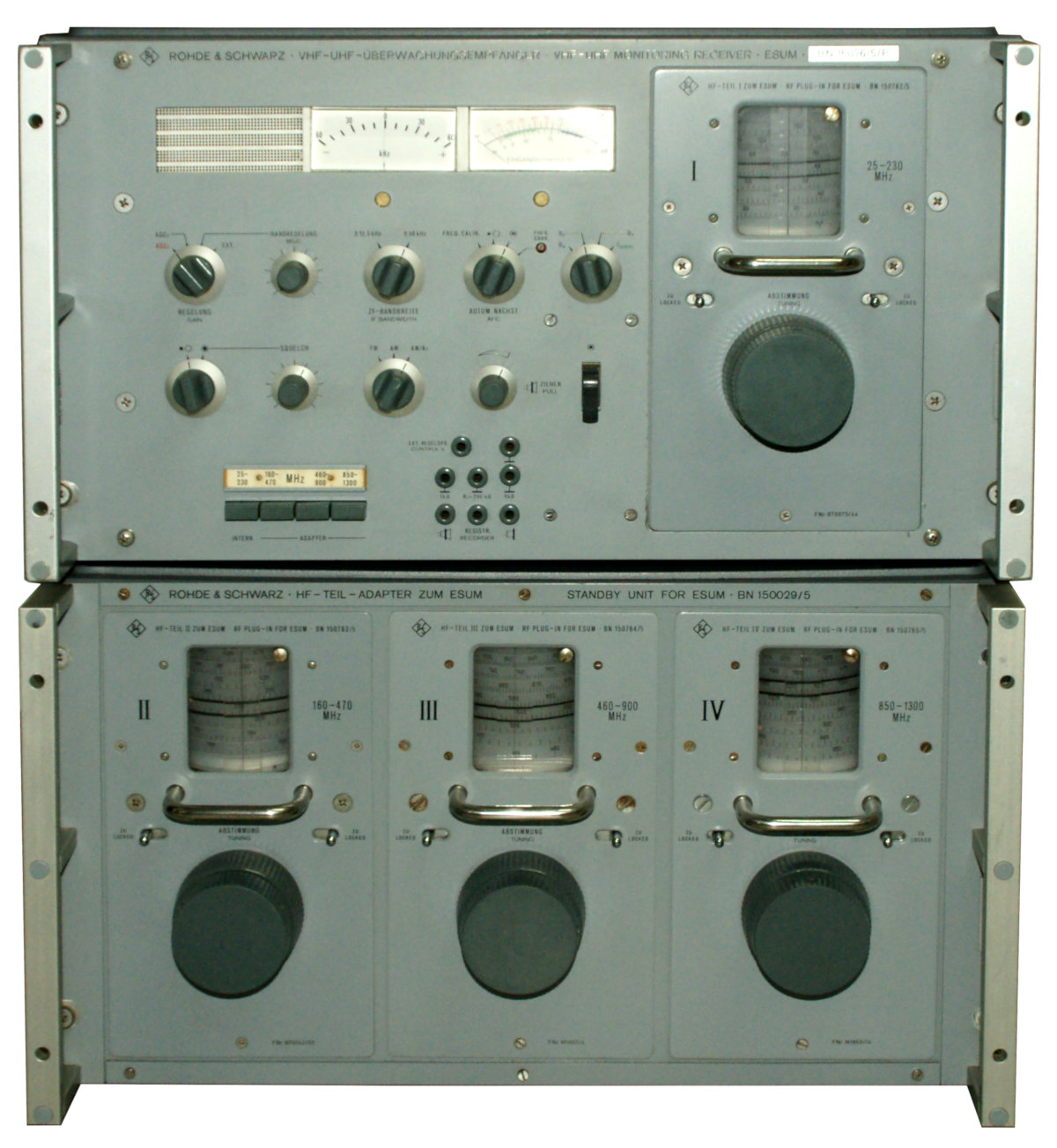
VHF/UHF measuring receiver ESUM, BN 150021/2, manufactured by Rohde & Schwarz, Munich.
The ESUM measuring receiver was developed by Rohde & Schwarz in the late 1960s as the successor to the ESU; the set was supplied with different frequency adapters for the different frequency ranges. The various frequency adapters could be operated directly from the main unit using the BN 150029 RF unit adapter.
Technical data
- Principle]]: double / triple superhet, IF (76 or 120) / 21.4 / 2 MHz
- Frequency memory: none
- Signal strength indicator: calibrated S-meter
Power supply
- Mains operation: 115, 125, 220, 235 V
- Batteries: 12 / 24 V
Dimensions
- Basic receiver: 430 x 300 x 440 mm, weight 30 kg
- HF unit adapter
Accessories
- Frequency unts RF I (25 - 230 MHz), RF II (160 - 470 MHz), RF III (460 - 900 MHz), RF IV (850 - 1300 MHz)
- R&S supplied a wideband dipole antenna BN 1500202 and a logarithmic-periodic antenna BN 1500203 as receiving antennas
- Mains cable part number 15001-4.42 and battery cable SN 15001-4.43 with two battery terminals, the pins for the mains cable and battery supply are wired differently on the cable coupling, which is screwed to the front of the set, so if there are battery terminals on the cable, do not apply mains voltage!
- Panorama display ESUP BN 1500211 or Analyskop EZF BN 15091
- Frequency counter FET3 BN 4738, cable BN 9111505
Operation
The VHF - UHF measuring receiver ESUM with the BN 150021/2 in its sturdy metal cabinet weighs 30 kg and has four frequency units to cover the entire VHF/UHF range. With the HF units adapter, the frequency units can be switched from the base receiver; the antenna connectors and the power socket are located on the rear of the adaper units.
Using different power supply cables, the set can be operated from 220 V mains voltage or 12 V battery power, for example for field strength measurements in the field.
The set can be used as a measuring receiver for radio monitoring and field strength measurements.
The receiver can demodulate FM transmissions (bandwidth ±60 kHz for modulated transmissions and ±12.5 kHz for carrier measurements), AM transmissions and also unmodulated carriers A1 by means of a built-in BFO.
The small monitor loudspeaker, the instrument for displaying the signal centre and the signal strength instrument are located at the top left of the front panel.
Below this are the other controls in two rows and, at the bottom, the four pushbuttons for selecting the four frequency ranges or frequency adapters.
In the bottom row of controls, the mains switch is located on the far right, next to it the volume control, pulling it out activates the monitor loudspeaker. To the left, you find the operation mode selector for A1, A3 and F3 reception and, further to the left, the squelch switch and the corresponding squelch threshold control.
In the upper row of controls, from the right, are the measuring instrument switch, the switch for the AFC (automatic frequency correction) and the 10 MHz crystal calibrator, the controls for the IF bandwidth of ± 12.5 and ± 60 kHz and the controls for automatic and manual control of the RF gain. In the red marked position AGC1, the measuring instrument displays the signal level in logarithmic scale from 2 μV - 10 mV (0 - 80 dB (μV)), in position AGC2 the control range of the AGC is 2 μV - 1 V. In the MGC position, the RF gain can be controlled manually.
Technical principle
Double / triple superhet with frequency units for the four frequency bands with spiral analogue dial.
Components
It is unclear to what extent the VHF / UHF measuring receiver is still partially equipped with tubes; some functions are realised with semiconductors.
Technical documentation
- Unfortunately I do not have any

